OpenSees Cloud
OpenSees AMI
An OpenSees Manometer
21 Jun 2026 - Michael H. Scott
I’ve done several posts comparing OpenSees results to solved problems from J.C. Smith’s Structural Analysis, which I used in college, and other textbooks on structural analysis.
I am confident OpenSees can solve every linear structural analysis problem in those books, so it’s about time I move on. Although I’m sure I’ll return to solve some nonlinear structural analysis textbook problems before long.
In addition to Smith’s Structural Analysis, I also held on to my undergraduate fluid mechanics textbook, Fundamentals of Fluid Mechanics (2nd edition) by Munson, Young, and Okiishi.
Compared to structural analysis problems, the percentage of fluid mechanics problems OpenSees can solve is lower. But how much lower? To find out, we have to start somewhere and keep pushing until we reach problems I know OpenSees cannot solve, like turbulent flow. At least not yet.
We are not starting from zero though. Previous posts have verified the PFEM in OpenSees for hydrostatic pressure in a tank and hydrostatic loading on a cantilever. For demonstration’s sake, I have also simulated fluid sloshing during an earthquake.
This post shows how to use OpenSees to simulate a manometer, which is a device used for measuring the pressure of liquids or gases. I realize nobody is going to use OpenSees to measure pressure. Instead, the post verifies multi-fluid hydrostatics for a problem with a known closed-form solution.
Example 2.4 from Munson et al looked like a good candidate for this type of verification. The problem consists of a closed tank partially filled with oil and connected to a U-shaped pipe filled with oil and mercury. The problem is to solve for the air pressure in the tank, which the authors show is 3.06 psi.
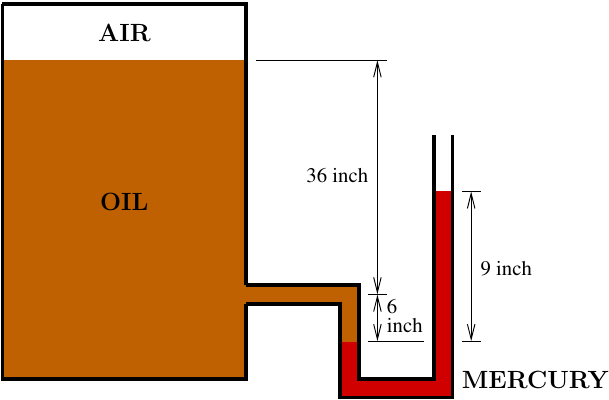
The specific weight and viscosity of the oil, mercury, and air are listed below.
| Fluid | Specific Weight (lb/ft3) | Viscosity (lb-sec/ft2) |
|---|---|---|
| Oil | 56.2 | 8.0e-3 |
| Mercury | 849 | 3.28e-5 |
| Air | 0.0765 | 3.74e-7 |
Only the relative heights of the oil and mercury are important for this problem.
Details of the OpenSees model and analysis are omitted from this post for brevity. The script is not too long, but there are a few steps to define the tank, the tube, and three different fluids (oil, mercury, and air).
Fast forward through the OpenSees PFEM analysis using a background mesh and incompressible bubble elements…
The computed air pressure of just over 3.03 psi is constant with time and is within 1% of the textbook solution. I’d call that a success.
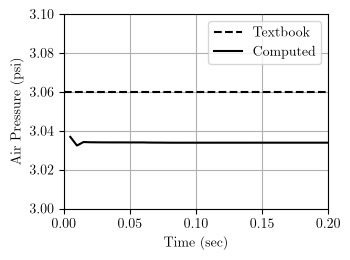
Although not shown here, the computed air pressure does approach the exact solution when using a finer mesh of PFEM elements.
The oil and air pressures in the tank, as well as the pressure of the mercury in the manometer tube, are shown below.
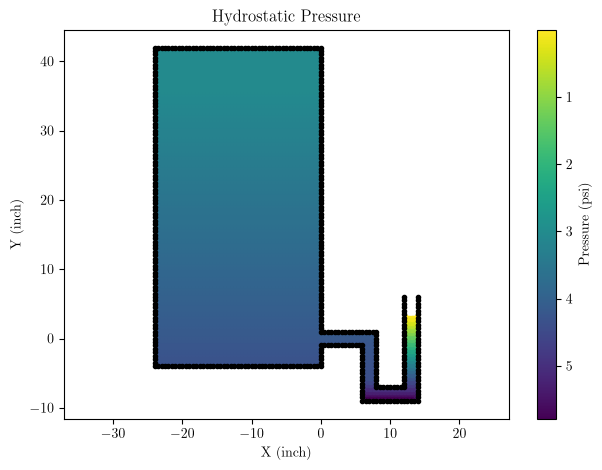
As expected, the pressure gradient in the dense mercury is higher than that in the oil. Before moving on to fluid dynamics, future posts will address other problems in fluid statics.