OpenSees Cloud
OpenSees AMI
A Moment of Constant Confusion
30 Sep 2026 - Michael H. Scott
Despite writing about getting OpenSees analyses right, there are things I’ve been getting wrong for years.
One mistake I repeatedly make is assuming the torsional constant, J, is equal to the polar second moment of area, Ip=Iy+Iz, commonly referred to as the polar moment of inertia.
And I’m not the only one who makes this mistake. I saw J=Iy+Iz used incorrectly in a recently published textbook on structural analysis.
The relationship J=Iy+Iz is true for circular cross sections, so why not for other sections? The units work out, the polar moment of inertia is easy to remember, and if it works for one case…
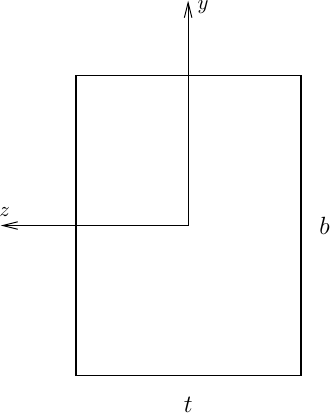
Besides, even for a simple rectangular section of width, b, and thickness, t, the expression for the torsional constant is hard to remember. Without getting down into the weeds of warping and Saint-Venant torsion, the torsional constant is approximately:
\[J \approx \frac{bt^3}{3} \left( 1 - 0.63\frac{t}{b} \left( 1-\frac{t^4}{12b^4} \right) \right)\]where b>t. The high order term, t4/(12b4), vanishes in a hurry when b>t and we can use a simpler approximation:
\[J \approx \frac{bt^3}{3} \left( 1 - 0.63\frac{t}{b} \right)\]If the width is much larger than the thickness (b»t), e.g., for a plate, the torsional constant is approximately J=bt3/3.
Plaut and Eatherton (2017) give a concise summary of a rectangular section’s exact torsional constant, which involves an infinite series and hyperbolic tangent, along with the progressively simpler approximations shown above.
Turning to the polar moment of inertia, we can factor out bt3/3
\[I_p = \frac{1}{12}bt^3 + \frac{1}{12}b^3t = \frac{bt^3}{3} \left( \frac{1}{4} + \frac{b^2}{4t^2} \right)\]Then, the plot below shows the factors that multiply bt3/3 in the expressions for J and Ip as the width-to-thickness ratio, b/t, increases.
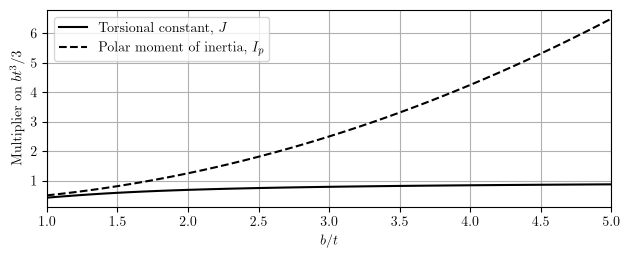
From this plot, we can make the following observations:
- For solid rectangular sections, the polar moment of inertia always overestimates the torsional constant.
- For nearly square sections with b/t<1.5, the polar moment of inertia is a reasonably close approximation of the torsional constant.
- For solid rectangular sections with b/t>2, the polar moment of inertia grossly overestimates the torsional constant.
- For flatter rectangular sections, bt3/3 becomes a very good approximation of the torsional constant as b/t increases.
Why is this important? The input for J in the OpenSees
elasticBeamColumn element should be the torsional constant, not the
polar moment of inertia. And when you aggregate torsion, GJ, to a
fiber section, you should use the torsional constant, J, not the polar
moment of inertia.