OpenSees Cloud
OpenSees AMI
Hock Around and Find Out
22 Nov 2026 - Michael H. Scott
The cable hockling example developed by Nour-Omid and Rankin (1991) is a good test case for geometric instability of a flexible rod subjected to torsion.
The cable is completely fixed at one end, while at the other end, the cable is able to displace axially and twist, with all other DOFs fixed.
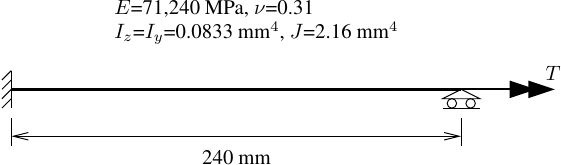
In her Ph.D. dissertation, Veronique Le Corvec analyzed the cable’s hockling response using a corotational mesh of 20 linear-elastic beam elements.
Can we get similar results? Let’s OpenSees and find out.
The paper by Nour-Omid and Rankin does not specify a cable cross-sectional area. To create the OpenSees model, I assumed the section area to be A=3.66 mm2. Also, the cable is defined with an L/500 initial imperfection.
import openseespy.opensees as ops
from math import pi,sin

N = 1
mm = 1
MPa = N/mm**2

E = 71240*MPa
v = 0.31
G = 0.5*E/(1+v)

Iz = Iy = 0.0833*mm**4
J = 2.16*mm**4
A = 3.66*mm**2 # Assumed

L = 240*mm
Nele = 20
dL = L/Nele

ops.wipe()
ops.model('basic','-ndm',3,'-ndf',6)

ops.node(0,0,0,0); ops.fix(0, 1,1,1,1,1,1)

ops.geomTransf('Corotational',1,0,0,1)

y0 = L/500
for i in range(1,Nele+1):
    x = i*dL
    ops.node(i, x,y0*sin(pi*x/L),0)
    ops.element('elasticBeamColumn',i,i-1,i,A,E,G,J,Iy,Iz,1)

ops.fix(Nele, 0,1,1,0,1,1)

ops.timeSeries('Linear',1)
ops.pattern('Plain',1,1)
ops.load(Nele, 0,0,0,1,0,0)

Umax = 2*pi
Nsteps = 500
dU = Umax/Nsteps

ops.system('UmfPack')
ops.integrator('DisplacementControl',Nele,4,dU)
ops.analysis('Static','-noWarnings')

for i in range(Nsteps):
    ok = ops.analyze(1)
    if ok < 0:
        break
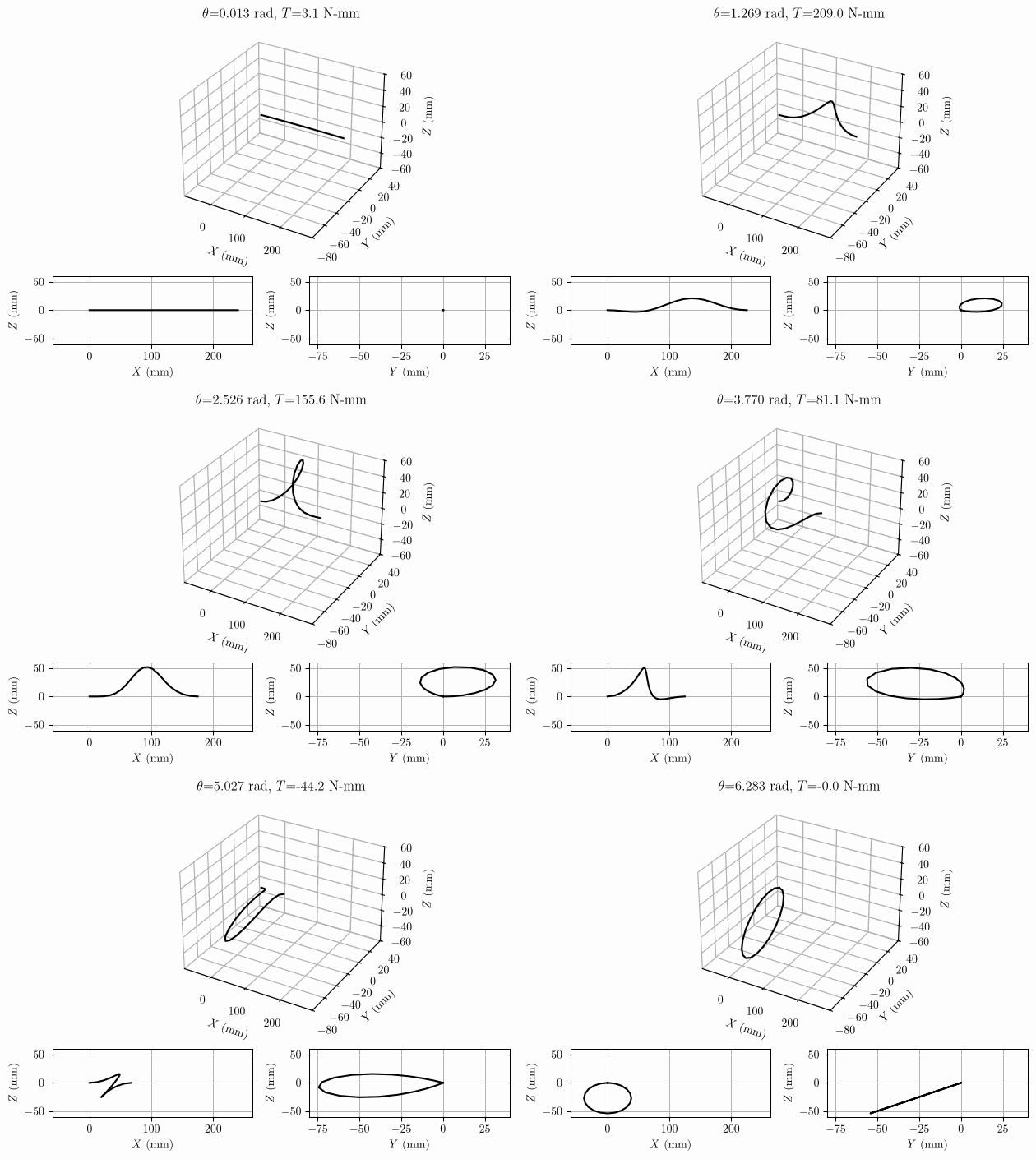
The torque-twist response is shown below for a full revolution of the cable end. The solution becomes unstable at approximately π/4 radians. To maintain an increasing end twist under displacement control, the end torque decreases and eventually reverses at about 3π/2 radians before returning to zero at one complete revolution.
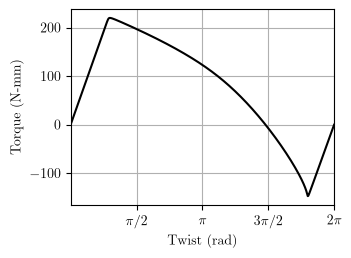
Due to what I believe to be an inconsistent tangent in the OpenSees implementation of the 3D corotational transformation, analysis convergence is finicky as the twist angle increases.
At any rate, an animation of the simulation is shown below, where the cable curls up into a circle. Pretty cool!