OpenSees Cloud
OpenSees AMI
NAFEMS Test P18.FV73
Benchmark Summary
| Item | Value |
|---|---|
| Category | Free Vibration |
| Structure | Cantilevered Thin Square Plate |
| Analysis Type | Eigenvalue Analysis |
| Quantity Verified | Frequencies |
| Elements Evaluated |
ShellMITC4, ShellDKGQ, ASDShellQ4
|
| OpenSees Version | 3.8.0.0 |
| Operating System | Ubuntu |
| Status | Verified |
Revision History
- September 4, 2026 – Corrected description of
ShellMITC4formulation; modified note onASDShellQ4; added link toopstool - August 3, 2026 – Initial version
Objective
This test assesses shell element performance in finding the natural frequencies of a Cantilevered Thin Square Plate.
Geometry and Mesh
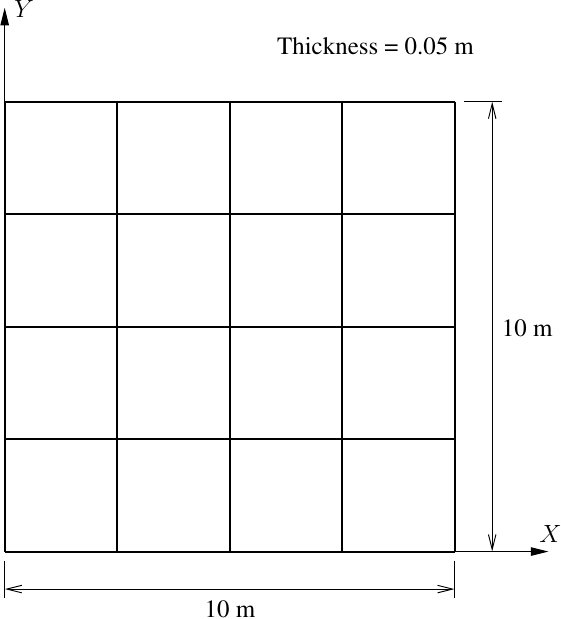
The model is a 4x4 mesh of shell elements defined in three dimensions (3D). The original FV73 Test computes frequencies obtained for different mass DOF reductions via dynamic condensation. OpenSees does not perform mass reduction, so only Test 1 from FV73 is relevant for this test.
Boundary Conditions
- uX=uY=uZ= θY= 0 along X=0
Material Properties
- Elastic modulus, E = 200e9 Pa
- Poisson ratio, ν = 0.3
- Density, ρ = 8000 kg/m3
OpenSees Elements Tested
The original FV73 Test uses an eight-noded semi-Loof thin shell element. This element formulation is not available in OpenSees, so the test compares the following shell element formulations to the reference solution.
ShellMITC4ShellDKGQASDShellQ4
Note that each of these elements is a four-noded element.
Frequencies
Frequencies (Hz) along with percent difference from the reference solution.
| Mode 1 | Mode 2 | Mode 3 | Mode 4 | Mode 5 | Mode 6 | |
|---|---|---|---|---|---|---|
| Reference Solution | 0.421 | 1.029 | 2.582 | 3.306 | 3.753 | 6.555 |
ShellMITC4 |
0.422 (0.18%) | 1.045 (1.56%) | 2.940 (12.96%) | 3.596 (8.40%) | 4.214 (11.58%) | 7.511 (13.59%) |
ShellDKGQ |
0.415 (1.38%) | 1.020 (0.90%) | 2.695 (4.29%) | 3.439 (3.95%) | 3.896 (3.75%) | 6.994 (6.49%) |
ASDShellQ4 |
0.412 (2.23%) | 0.969 (5.97%) | 2.445 (5.43%) | 2.906 (12.87%) | 3.392 (10.12%) | 5.211 (22.85%) |
Among the elements considered, ShellDKGQ agrees most closely with the
NAFEMS reference solution. This element uses a thin plate formulation
with a consistent mass matrix. The ShellMITC4 element also uses a consistent
mass matrix, but the element’s thin plate formulation differs from ShellDKGQ. While ASDShellQ4
uses a thin plate formulation similar to ShellMITC4, its mass matrix is lumped. This benchmark
alone does not prove one element formulation is better than the others.
Mode Shapes
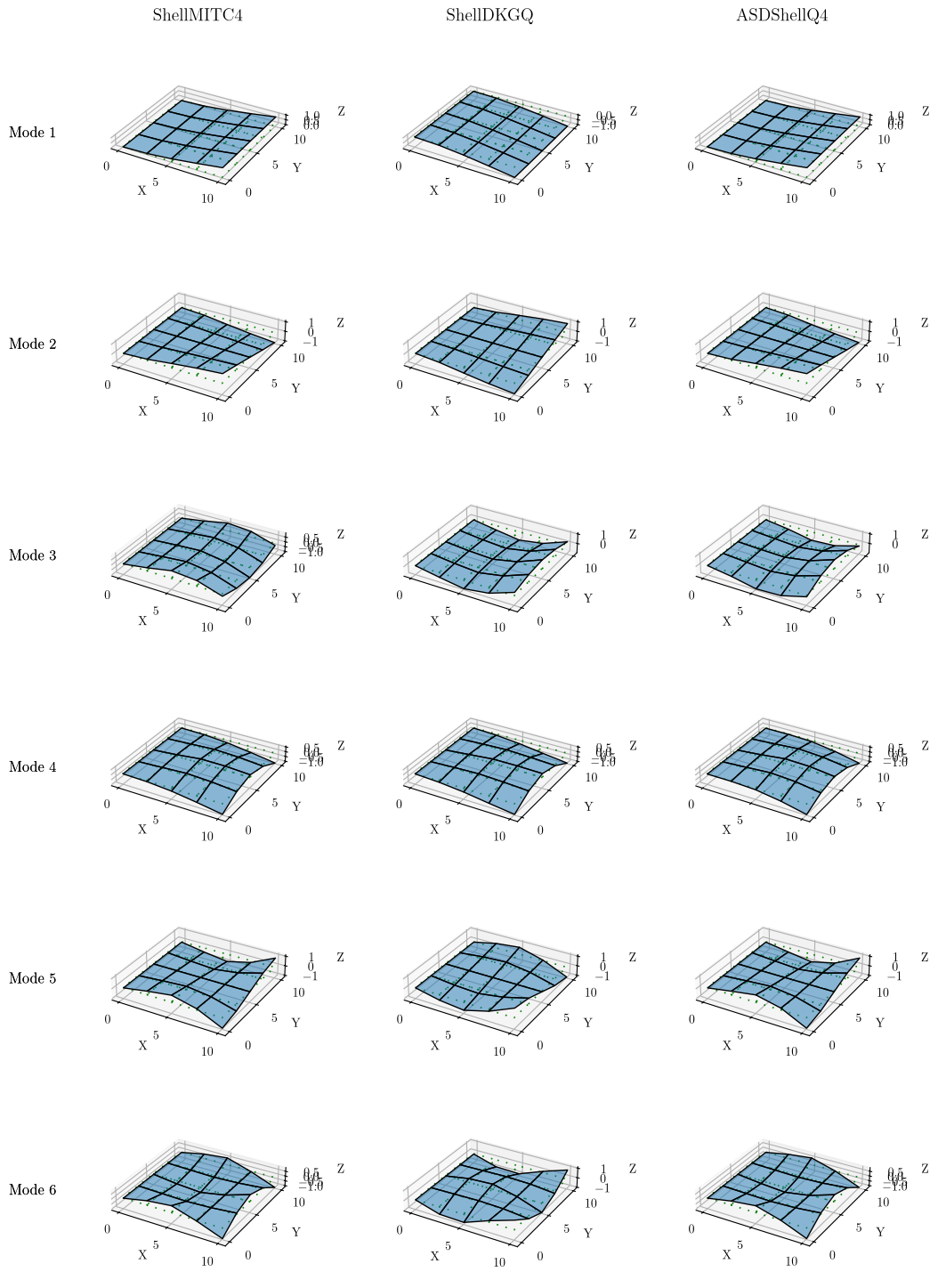
The mode shapes returned by all three element formulations are shown below. The mode shapes are consistent between the formulations, taking into account differences in algebraic sign for some eigenvectors, and provide an additional qualitative verification beyond the natural frequencies.
OpenSees Script
import openseespy.opensees as ops

from numpy import pi,sqrt

# Units = N, m, sec

L = 10
t = 0.05
E = 200e9
v = 0.3
rho = 8000

Nmodes = 6

ops.wipe()
ops.model('basic','-ndm',3,'-ndf',6)

ops.node(1,0,0,0)
ops.node(2,L,0,0)
ops.node(3,L,L,0)
ops.node(4,0,L,0)

c = L/4 # Mesh size

ops.mesh('line',1,2,*[1,2],0,6,c)
ops.mesh('line',2,2,*[2,3],0,6,c)
ops.mesh('line',3,2,*[3,4],0,6,c)
ops.mesh('line',4,2,*[4,1],0,6,c)

ops.section('ElasticMembranePlateSection',1,E,v,t,rho)
# For `ASDShellQ4`, see note below
ops.mesh('quad',5,4,*[1,2,3,4],0,6,c,'ShellMITC4',1) # Or 'ShellDKGQ'

ops.fixX(0,1,1,1,0,1,0)

w2 = ops.eigen(Nmodes)
f = sqrt(w2)/(2*pi)
Notes
- The
meshcommand does not currently work withASDShellQ4. Instead, you can useblock2Dor the meshing approaches implemented inopstool.
Verification Summary
Among the shell elements considered, ShellDKGQ is in closest agreement
with the published reference frequencies. All three formulations give
consistent mode shapes.