OpenSees Cloud
OpenSees AMI
Stop Cargo Culting BandGeneral and Plain Numberer
17 Feb 2026 - Michael H. Scott
In the early days of OpenSees, perhaps in its G3 infancy, an example Tcl
script used BandGeneral for the system and Plain for the numberer.
numberer Plain
system BandGeneral
Who created the script, or why they chose those analysis options, is unimportant now–it could have been me for all I know. But this pair of commands has been posted online and copied into so many other Tcl scripts–and now Python–that someone new to OpenSees might assume these options are best practice.
The
cargo culting
has gone so far that if you ask ChatGPT to generate an
OpenSees analysis script for a cantilever, chances are pretty good
you’re going to get BandGeneral for the system and Plain for the
numberer.
Go ahead and try it yourself (click the link, then hit Enter). Did you get the cargo culted analysis options? If not, maybe this post has already done its job.
To be fair, these options are fine for the small examples found at a workshop or in a classroom, but this combination of solver and numberer does not scale well to larger models.
In a
previous post
on the performance of all linear equation solvers and
equation numberers available in OpenSees, we saw that BandGeneral is
not the best solver, and also not the worst. However, the numberer does make a significant difference for this solver.
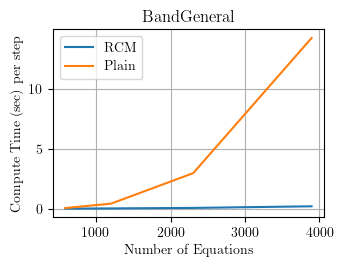
So if you’re going to use BandGeneral, at least switch to the RCM
numberer, which will reduce the matrix bandwidth. But don’t use AMD,
because its minimization of fill-in can lead to high matrix bandwidth,
which is not good for banded equation solvers.
ops.numberer('RCM')
ops.system('BandGeneral')
As you get into larger models, you’ll want to use a sparse equation
solver like SparseGeneral, UmfPack, or Mumps that only stores
non-zero matrix entries.
ops.numberer('RCM') # or 'AMD'
ops.system('UmfPack')
Cargo is harmless for toy models. When you scale up, inspect the contents before they become your standard practice.